The State of Boreal Chickadees in the Northeast United States
Increasing
This small population has likely at least doubled since 2010
Boreal Chickadee population changes, with 95% credible intervals, as based on Mountain Birdwatch monitoring data within each region from 2010-2025. Boreal Chickadees do not breed in the Catskills, and their population in Vermont is restricted to the Northeast Kingdom, and is only reliably detected on a single route (East Mountain) in Vermont.
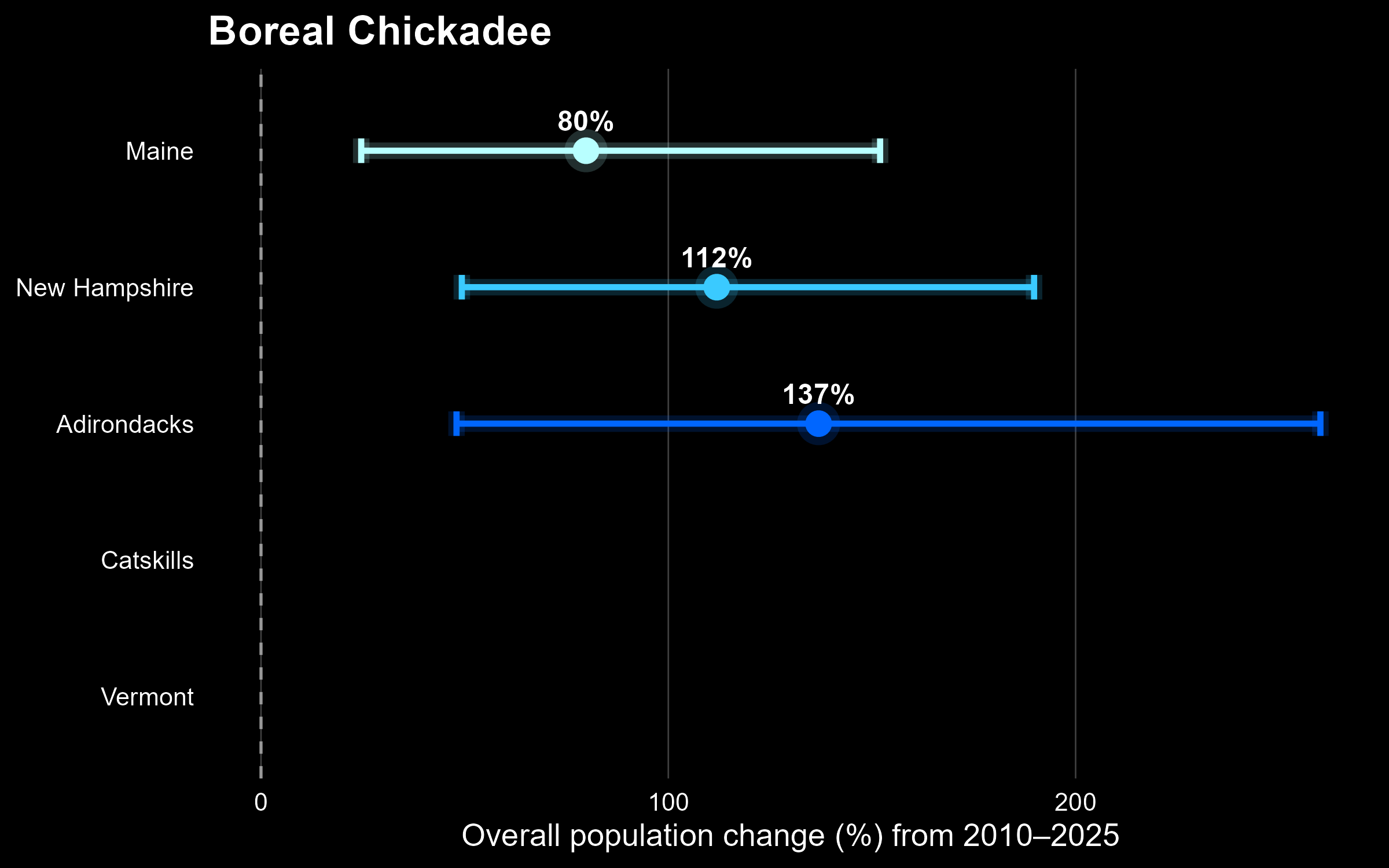 In our region, sizable populations of Boreal Chickadees only occur in Maine, New Hampshire, and the Adirondacks of New York. They are not known to breed in the Catskills, and are only reliably (and sparsely) found in the Northeast Kingdom of Vermont during the summer where they are occasionally detected on the East Mountain Mountain Birdwatch route. Mountain Birdwatch data suggest that Boreal Chickadee populations in the northeastern United States have likely been increasing since 2010 at a mean annual rate of less than 5%. Keep in mind, the trends below are based on relatively few detections of this species each year. Only a few Boreal Chickadees are detected within Vermont during Mountain Birdwatch, and not in every year; therefore, their population status in Vermont is uncertain, but likely mimics those of the surrounding states. Boreal Chickadees are less conspicuous compared to Black-capped Chickadees, and Boreal Chickadees may maintain large (10-acre) territories where they may move about to find higher densities of food.
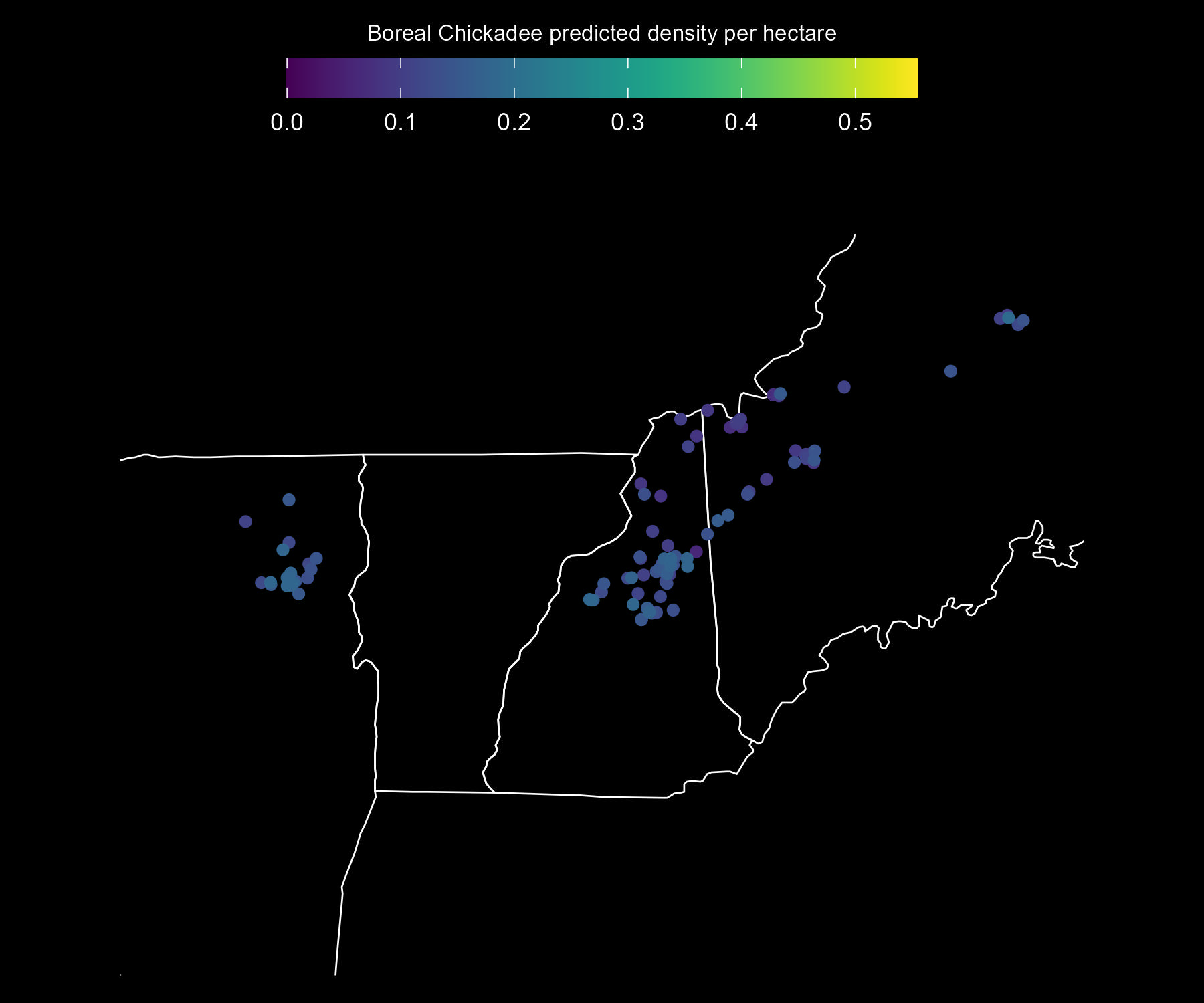
Predicted Boreal Chickadee adult density per approximate hectare, as estimated from Mountain Birdwatch data. The base map shows the extent of the Mountain Birdwatch region: eastern New York, Vermont, New Hampshire, and western Maine.
Population trends for Boreal Chickadee from 2010–2025 based on Mountain Birdwatch monitoring data. Values show the estimated mean annual population change (%) and the cumulative population change (%) since 2010, each with 95% Bayesian credible intervals (CRI). Colored dots indicate the direction and strength of evidence for a trend. Strong evidence occurs when the 95% CRI does not include zero. The probability of increase (0–1) reflects the proportion of model estimates indicating a positive population change.
| Region | Annual trend (%) | Trend (95% CRI) | Probability of increase | Population change (%) 2010-2025 | Population change (95% CRI) |
|---|---|---|---|---|---|
| All regions | ●4.76 | (3.19, 6.35) | >0.99 | 102.0 | (60.2, 151.8) |
| Maine | ●3.88 | (1.48, 6.36) | >0.99 | 79.8 | (24.6, 152.0) |
| New Hampshire | ●5.04 | (2.71, 7.35) | >0.99 | 111.9 | (49.3, 189.8) |
| New York (Adirondacks) | ●5.75 | (2.65, 8.92) | >0.99 | 136.9 | (48.0, 260.1) |
| New York (Catskills) | NA (no breeding population) | NA | NA | NA | NA |
| Vermont | NA (data too sparse) | Unknown | Unknown | Unknown | Unknown |
● strong decline
● weak decline
● weak increase
● strong increase
Globally: Slightly Declining
Because they occupy remote areas without road access, and because they tend to be quiet and secretive during the breeding season, Boreal Chickadees are not well-monitored by the Breeding Bird Survey. Keeping that in mind, the Breeding Bird Survey data suggest slight declines over the last 50 years in the Eastern U.S., and stable populations in much of Canada. Conversely, eBird trends suggest steady (and in some cases substantial) declines across the southern portion of the Boreal Chickadee breeding range.
Boreal Chickadee habitat is at risk of disappearance due to climate change. Recent climate modeling predicts that >50% of the current range of Boreal Chickadees will be lost over the next 100 years as temperatures increase. By the end of this century, it is probable that Boreal Chickadees will no longer occur in the lower 48 states.